Uncategorized

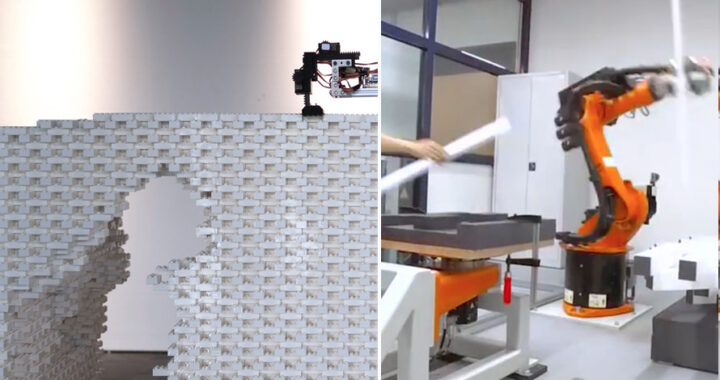
Henriette Bier and the Robotic Building lab at TU Delft organise a symposium on ‘Human-Robot Interaction for Post-Carbon Architecture’ together with LU Hannover.
ORGANISERS
Henriette Bier (TU Delft) and Mirco Becker (LU Hannover)
SPEAKERS/GUESTS
Henriette Bier and Luka Peternel (TU Delft); Mirco Becker and Lukas Lachmayer (LU Hannover); Oliver Tessmann (TU Darmstadt); Daniela Mitterberger (ETHZ); Serban Bodea (ETHZ/U Stuttgart); Alisa Andrasek (RMIT); Valentina Soana (UC London); Verena Vogler (McNeel); Maria Yablonina (U Toronto); Brian Ringley (Boston Dynamics).
Speaker Bios and Abstracts: http://www.roboticbuilding.eu/hri4pca-speakers/
DATE
29/04/2022
ABSTRACT
The Architecture, Engineering and Construction (AEC) industry is facing a threefold challenge involving the (1) digital transformation of all design and planning processes, (2) automation of construction processes, and (3) reconsideration of energy, process, and material use. This challenge involves issues of productivity, scalability, safety, labour skill shift, and environmental impact. There is a particular urgency in transferring effective solution from research to building practice to meet significant carbon reduction goals by 2040.
The one-day symposium is an opportunity to make an inventory of current tendencies in autonomous construction and human-robotic interaction in architecture. It aims at affirming and/or challenging research agendas in the domain of architectural robots. The leading questions for the symposium are:
- What are the fundamental research questions for framing post-carbon autonomous construction?
- What are the interdependencies between machines, humans, and materials?
- How do different implementation timeframes define strategies for transferring research, as for instance, continuous transformation vs. leapfrogging?
FORMAT (HYBRID)
By inviting a selected set of speakers and guests, the organisers aim at delivering tangible results with respect to the posed leading questions in two sessions: The morning session will be reserved for lectures and Q&A and the afternoon session is dedicated to a workshop with the goal of establishing a network for framing new collaborative projects. Results will be published in Spool CpA (see most recent issue https://spool.ac/index.php/spool/issue/view/20).
PROGRAM
Join Zoom Meeting
https://tudelft.zoom.us/j/95130196193
9:00-9:15h Intro by Henriette Bier (TU Delft) and Mirco Becker (LU Hannover)
9:15-11:00h Session 1 moderated by Valentina Soana (UC London)
9:15-9:45h Henriette Bier and Luka Peternel (TU Delft)
9:45-10:15h Mirco Becker and Lukas Lachmayer (LU Hannover)
10:15-10:30h Oliver Tessmann (TU Darmstadt)
10:30-10:45h Serban Bodea (ETHZ / U Stuttgart)
10:45-11:15h Q&A
11:15-11:30h Break
11:30-12:45h Session 2 moderated by Oliver Tessmann (TU Darmstadt)
11:30-11:45h Maria Yablonina (U Toronto)
11:45-12:00h Daniela Mitterberger (ETHZ)
12:00-12:15h Alisa Andrasek (RMIT)
12:15-12:30h Valentina Soana (UC London)
12:30-12:45h Brian Ringley (Boston Dynamics)
12:45-13:00h Q&A
13:00-14:00h Break
14:00-15:45h Workshop moderated by Mirco Becker (LU Hannover) and Henriette Bier (TU Delft)
15:45-16:00h Closing


Intro to MSc 2 workshop ‘Interactive Furniture’ implemented in collaboration with CitG, EWI, and 3ME is on 11th February, 9:00h, in room U, at BK, TU Delft!
The MSc 2 course on Interactive Furniture (IF) will focus on the development of parametric designs for robotically produced and assembled furniture using 3D printed nodes and wood elements of variable size. The design takes functional, structural, material, and operational aspects into account. It integrates sensor-actuators into the furniture enabling communication with users via sounds, lights, etc. and web-based apps, respectively. The focus will be on two main aspects of the design: (1) Computational design and robotic assembly (workshop) and (2) Computational design, robotic production, assembly, and user-driven interaction based on sensor-actuator operation (studio). The MSc 2 course is taught in collaboration with the faculties CitG, EWI, and 3ME. Prototyping is implemented with support of TU Library acting as client and Dutch Growth Factory contributing in-kind as industrial partner.
