ArchiSpace: Space architecture design and prototyping in planetary analogue environments
Year: 2024-28
Project leader TUD: Henriette Bier
Project team TUD: Henriette Bier, Arwin Hidding, Raj Rajan, and Prem Sundaramoorthy
Collaborators / Partners: IRSPS SRL, Portucalense University (UPT), The University Claude Bernard Lyon 1 (UCBL), Vertico BV, Research Centre for Astronomy and Earth Sciences (CSFK or RCAES), space-craft Architektur, Cadi Ayyad University (UCAM), and D'Annunzio University of Chieti–Pescara (Ud'A)
Funding: MSCA (EU funding programme for doctoral education and postdoctoral training of researchers)
In this decade the aim is to permanently inhabit the Moon. It is therefore crucial to develop reliable and safe settlements that adequately protect astronauts physical and mental well-being from all possible the hostile environment that the extraterrestrial space presents. ArchiSpace aims to design and build sub-systems prototypes (e.g., walls, roofs, living spaces, etc.) of human infrastructures to be built on planetary surfaces, which will be tested in analogue environments. This project aims to use environmental and geological setting analogues as a base to define architectural constraints, sketch design and prototypes to be used in future space human settlements. ArchiSpace is pioneering interdisciplinary and intersectoral research in Europe by bridging geology/space sciences and architecture/space architecture. Geology/space science is crucial because the subsurface plays a fundamental role in the selection of the landing sites and the location of 'human-focused' habitats. Architecture/space architecture has a key role in designing and prototyping comfortable, safe and functional habitats. Thus, ArchiSpace promotes an innovative international, inter-sectoral and interdisciplinary research and innovation collaboration that can contribute to Europe's competitiveness and growth.
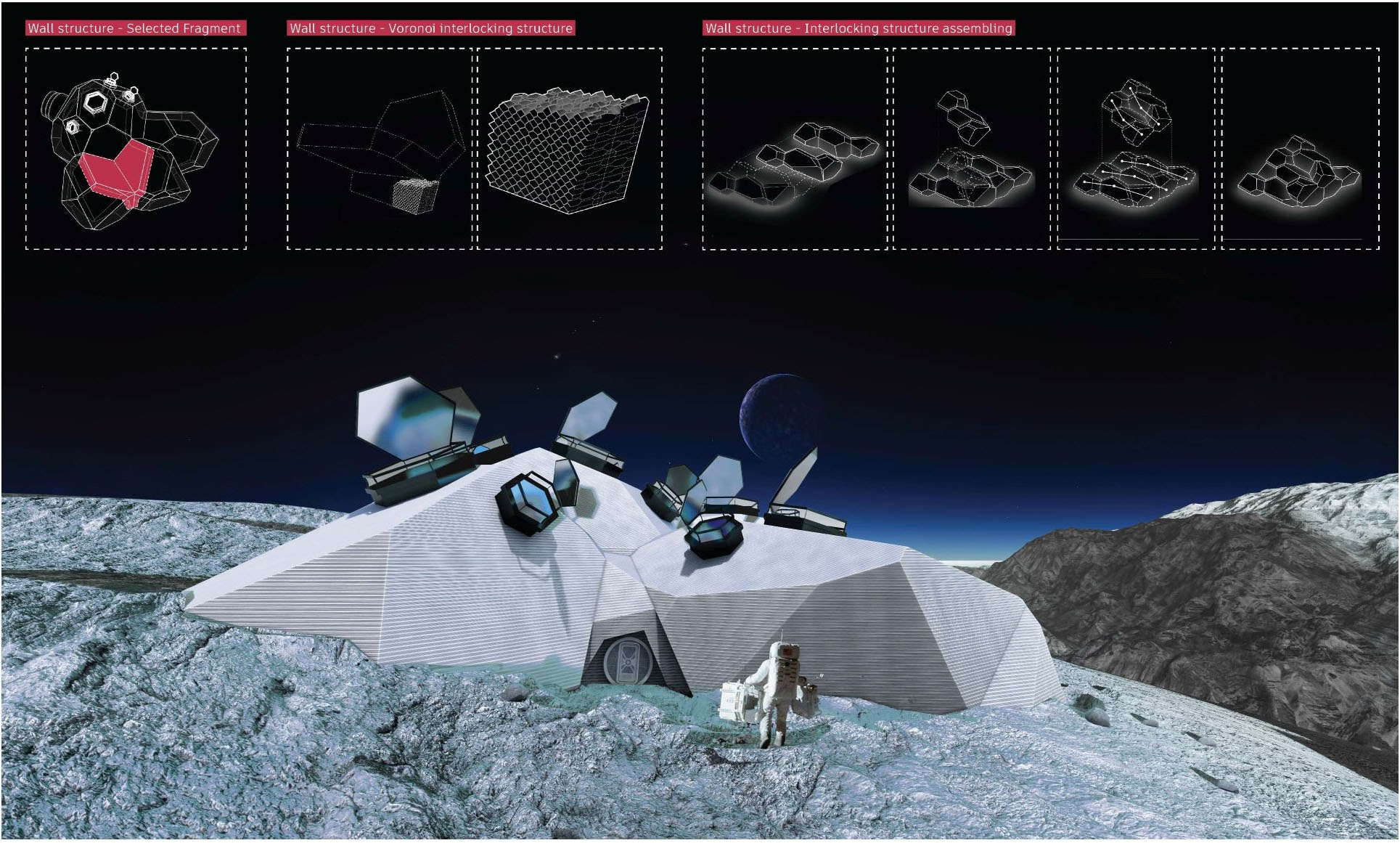
Moon Station competition entry of MSc 2 students 2024 (View project)
The study Interactive Furniture for Arctic Environments has been implemented in an extreme environment, Antarctica, where conditions include extremely cold, dry, and windy polar desert characterized by severe temperatures (ranging from -80 to -20), strong katabatic winds, minimal precipitation, and very low humidity; extreme light cycles with months of continuous daylight or darkness, high UV exposure, reduced oxygen levels. In this context the Norwegian research station in Antarctica, Troll, consisting of containers, is struggling with the limited space that confines activities and limits various and changing needs of inhabitants with respect to work, rest, and leisure. Furthermore, health is highly sensitive to lighting conditions because of their impact on the circadian rhythms, sleep, hormone cycles, visual performance, mood, and spatial orientation. Inadequate or poorly tuned lighting may impair alertness, mental health, immunity, and safety - making advanced, tunable, spectrum-controlled lighting systems essential. To address these challenges, the design focuses on developing reconfigurable, interactive furniture with integrated AI-supported embedded lighting for the Troll station, which is basically a collection of containers connected to each other.